Technology for Prevention

Farm Bill money extended by the United States Government has paved the way for several colleges and organizations to develop and test preventative measures against spontaneous combustion hay fire. When hay is stored with too much moisture it provides an environment for bacteria to grow in the bale. This chemical process generates heat, and when oxygen is introduced, it can combust, starting a fire. The technology created has been implemented by tractor and equipment manufacturers and is readily available to consumers. Some inventions and discoveries now available to farmers are moisture sensors, inoculants, preservatives, and moisture testers.
In 2002 Harvest Tec developed the first hay bale sensor. “The design makes use of a pair of star wheels that rotate as material flows over them, and allow for an electrical current to be established between them. The points of two wheels puncture the bale and act as the electrodes of the circuit. The resistivity of the bale can then be determined and related to the moisture content of the hay.” (Rasmussen & McGuire, 2019) This design has been tweaked and modified over the years and is built into many balers on the market today. John Deere provides the information gathered by sensors to the driver on a digital screen and is also published into an app. This information can be tracked and monitored by the farm manager.
Another approach that has been developed for farmers is the application of bacteria inoculants and preservatives directly to cut hay. The bacteria is applied to reduce mold growth and yeast development. The inoculants are more effective on wetter hay and act as a defense against small moisture changes. By reducing the mold and chemical changes these inoculants are also reducing the production of heat, making the hay less likely to spontaneously combust.
Preventatives and additives are designed to prevent heating. By adding preventatives to hay it can be baled wetter than is typically recommended. Preservatives are developed using acids that are sprayed onto the hay as it is being baled. Many new balers have barrels mounted on them. The barrels can be filled with these chemicals that are fed into a spray system and applied to the hay as it enters the baler. Preventatives wear off after a few months and are not effective at preventing heating long-term.

After the hay is baled and removed from the field, the moisture and temperature can be tested using technology that has been fine-tuned for accuracy. These testers look like giant digital thermometers. This tool features a long rod that is inserted into a bale and provides a moisture and temperature reading. Experienced farmers will note that a single bale can give off many different readings based on where the tester is inserted; in the center, or the edge. For this reason, the best practice is to test four different parts of a large bale and to check several bales in different locations of a stack for assurance and safety.
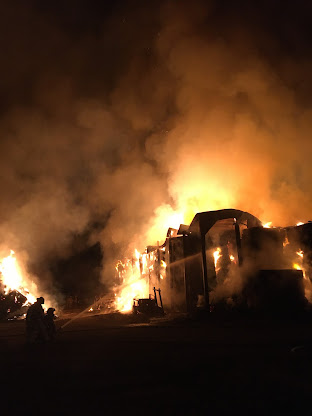
Even with all these resources available to farmers spontaneous combustion hay fires still occur. A farmer can do everything right and still fall victim to this unexpected tragedy.
Rasmussen, B. R., & McGuire, L. M. (2019, April). HAY MOISTURE SENSOR DESIGN FOR ROUND BALE COLLECTION. https://escholarship.mcgill.ca/downloads/0g354k83x
Bauder, S. B. (2021, October 15). Understanding Hay Inoculants and Preservatives on ‘Dry’ Hay. SDSU Extension. Retrieved March 23, 2022, from https://extension.sdstate.edu/understanding-hay-inoculants-and-preservatives-dry-hay
Hay Moisture Tester Protimeter Balemaster. (2022). [Photograph]. Tool Experts. https://www.toolexperts.com/hay-moisture-tester-protimeter-balemaster-grn6165.html


Comments