Better Practices for Prevention

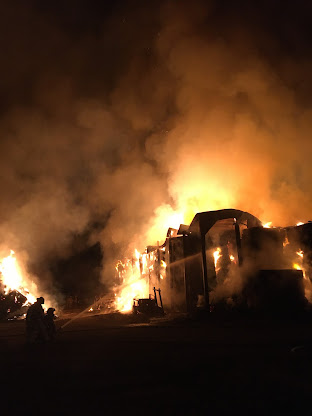
Cache Valley Fire Chief, Rod Hammer, shared some insights on spontaneous combustion that he has seen while fighting agriculture crop fires. Cache Valley Utah typically sees 1-2 spontaneous combustion hay fires each year on rural farms. Hammer explained that even when hay is baled at appropriate moisture levels the hay can still absorb moisture from rain or runoff on the ground after the bales are stacked. Hay that is turning will often smell caramelized but might be otherwise unrecognizable. In his experience grass hay retains more moisture than pure alfalfa making it susceptible to combustion. Rod suggests monitoring moisture levels before baling and stopping at 16% moisture in a one-ton bale. If the hay is treated with citric a farmer might stop at 21%. These numbers are consistent with data published by the North Dakota State University agricultural college. Many modern balers test moisture and provide that information to the farmer automatically. These numbers may vary compared to readings taken from the heart of a windrow with a handheld probe. Taking the time to manually check moisture levels will ensure more accurate information.
Another step that will help a farmer gain a higher degree of safety is post-baling temperature checks. These checks should be performed by inserting a long rod thermometer into the bale at different ends and angles. Farmers have reported getting several different readings from the same bale just minutes apart by taking measurements from both ends of the bale and checking the middle from the top and bottom. This practice of measuring bales at different locations in the stack should be repeated over the first 60 days of stacking hay.
In Ann Larkin Hansen’s book, Making Hay: How to Cut, Dry, Rake, Gather and Store a Nourishing Crop, She explains that if the hay is running hot it may be best to unstack it, but if the temperature is above 140 degrees F it may not be safe to. Ann explains, “letting oxygen into the hot spot may be just what is needed for a fire to start.” Instead, she suggests calling the fire department. While few farmers are known to check hay temperature after baling and storing their hay, Mrs. Hansen includes this council and highlights it as a best practice for safely making hay.
By taking the time to manually test moisture and temperature repeatedly, a farmer may prevent a spontaneous combustion hay fire. Although somewhat tedious these methods are quick and much more cost-effective than replacing a crop or a barn. Combustion happens and only diligent informed monitoring can consistently protect the farmer.
Schroeder, J. W. S. & North Dakota State University Extension and Ag Research. (2011, July 29). Don’t Risk Hay Fires. NDSU. Retrieved January 31, 2022, from https://www.ag.ndsu.edu/news/newsreleases/2011/july-25-2011/don2019t-risk-hay-fires/view
Cache County Fire District Logan, UT
County Fire Chief Rod Hammer
Comments