Posts

Showing posts from March, 2022

Technology for Prevention

Image
This John Deere baler features a preservative spray tank on the top. Farm Bill money extended by the United States Government has paved the way for several colleges and organizations to develop and test preventative measures against spontaneous combustion hay fire. When hay is stored with too much moisture it provides an environment for bacteria to grow in the bale. This chemical process generates heat, and when oxygen is introduced, it can combust, starting a fire. The technology created has been implemented by tractor and equipment manufacturers and is readily available to consumers. Some inventions and discoveries now available to farmers are moisture sensors, inoculants, preservatives, and moisture testers.  In 2002 Harvest Tec developed the first hay bale sensor. “The design makes use of a pair of star wheels that rotate as material flows over them, and allow for an electrical current to be established between them. The points of two wheels puncture the bale and act as the ele...
I Didn't Start the Fire

Image
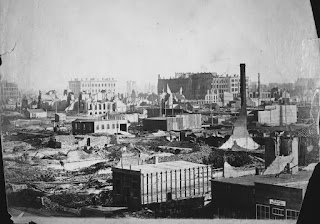
Chicago after the Great Chicago Fire in 1871 A hay fire started in a barn on the southwest side of Chicago, Illinois in 1871. This fire would sweep through the city over a 24 hour period killing 300 people and leaving one-third of the population homeless. A legend, known as The O’Leary Legend, began about how the Great Chicago Fire started. “Late one night, when we were all in bed, Mrs. O'Leary lit a lantern in the shed. Her cow kicked it over, Then winked her eye and said,  "There'll be a hot time in the      old town tonight!" These song lyrics have been expanded in works of art, poetry, books, plays, and film. This folklore used to explain this disaster has been handed down for generations.  A song written after the Great Chicago Fire A novel about the fire and Mrs. O'Leary's tale One of the films produced about Mrs.O'Leary and her family in Chicago According to research performed on this disaster “Kate O'Leary offered sworn testimony that she was i...

Firefighter Manpower

Image
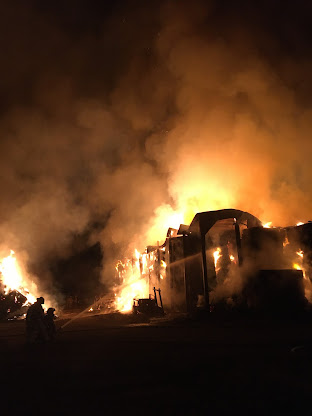
Firefighters work to put out a spontaneous combustion hay fire in Cache Valley Utah. When a hay fire spontaneously combusts on the farm, who are you gonna call? The fire department. In Cache County Utah the majority of agricultural fires are routed to the county department which handles rural areas. Cache County Fire Department has 14 stations operating to protect the valley. Nationally, there are an estimated 1.1M firefighters working across the country. Without these heroes, the rage of a spontaneous combustion hay fire would be unstoppable. When a spontaneous combustion hay fire ignites, there is mainly one option, let it burn. Firefighters line the landscape with hoses shooting water to protect the rest of the property. They work tirelessly to calm the flames and watch with as much control as the environment will lend them to keep it from spreading. Depending on the size of the fuel (in this case, the haystack) the firefighters could labor for hours or days.  A great probl...